Sabah is home to some of the most diverse rainforest ecosystems in Southeast Asia, where rivers, mangroves, and lowland forests create a natural habitat for a wide range of wildlife. This is why Sabah wildlife tours and Borneo wildlife safari experiences are strongly associated with wildlife observation rather than traditional sightseeing.
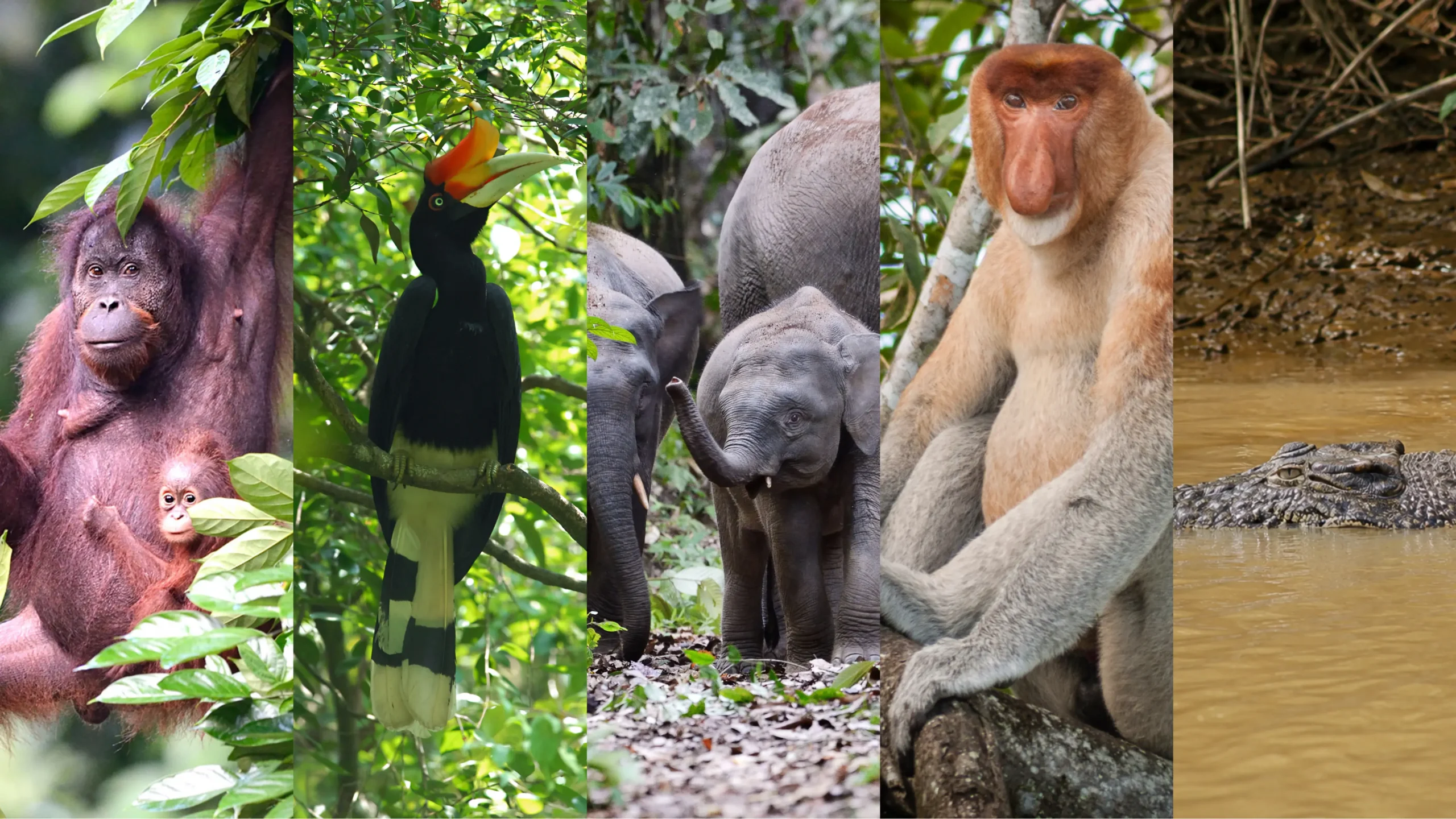
In tourism, the term “Borneo Big 5” is used to describe five iconic animal species often linked with wildlife journeys in Sabah. It is not a scientific classification, but a practical way to highlight species that represent the region’s ecological richness. These animals include the Bornean orangutan, Bornean pygmy elephant, proboscis monkey, rhinoceros hornbill, and estuarine crocodile.
Wildlife experiences in Sabah are based on natural encounters. Animals move freely in the forest and river systems, so sightings depend on timing, habitat conditions, and guide experience. River systems such as the Kinabatangan play a major role in supporting these encounters, making Kinabatangan wildlife tours one of the most recognised ways to explore Borneo’s rainforest environment.
The Borneo Big 5 is a tourism term used to group five of the most well-known wildlife species in Sabah. These animals are not selected based on rarity alone, but because they are strongly associated with rainforest ecosystems and are frequently highlighted in Sabah river safari animals experiences.
The list includes the Bornean orangutan, Bornean pygmy elephant, proboscis monkey, rhinoceros hornbill, and estuarine crocodile. Each of these species represents a different part of the ecosystem, from forest canopy life to river and wetland environments.
These animals also reflect the importance of conservation in Sabah. Forest corridors, river systems, and protected reserves all support their survival. Without these connected habitats, wildlife movement and breeding patterns would be heavily affected.

The Bornean orangutan is a large, tree-dwelling great ape known for its reddish-brown hair and long arms. It is one of the closest relatives to humans and shows complex behavior, including tool use and problem-solving in the wild.
In Sabah, orangutans live mainly in lowland and swamp forests. Common areas include the Kinabatangan floodplain, Danum Valley Conservation Area, and Tabin Wildlife Reserve. They depend heavily on forest trees for food and shelter, especially fruit-bearing species.
This species is classified as Critically Endangered, mainly due to habitat loss and fragmentation. Conservation programs in Sabah focus on protecting forest areas and reconnecting wildlife corridors.
In Kinabatangan wildlife tours, orangutans may sometimes be seen feeding or moving through trees near river edges. However, sightings are natural and cannot be predicted, as they move freely across large forest areas.

The Bornean pygmy elephant is the smallest subspecies of Asian elephant and is unique to Borneo. It is known for its relatively calm behavior, large ears, and long tail. These elephants live in small herds and require large forest areas for movement and feeding.
Their habitat in Sabah includes the Kinabatangan region, Tabin Wildlife Reserve, and forest zones connected to Danum Valley. They often travel along river systems and forest edges in search of food such as grasses, fruits, and bark.
This species is Endangered, mainly due to habitat loss and fragmentation caused by land development. Conservation efforts focus on protecting migration routes and reducing human-wildlife conflict.
During Borneo wildlife safari experiences, pygmy elephants may sometimes be observed near riverbanks or crossing forest paths. However, sightings remain unpredictable due to their wide movement range.
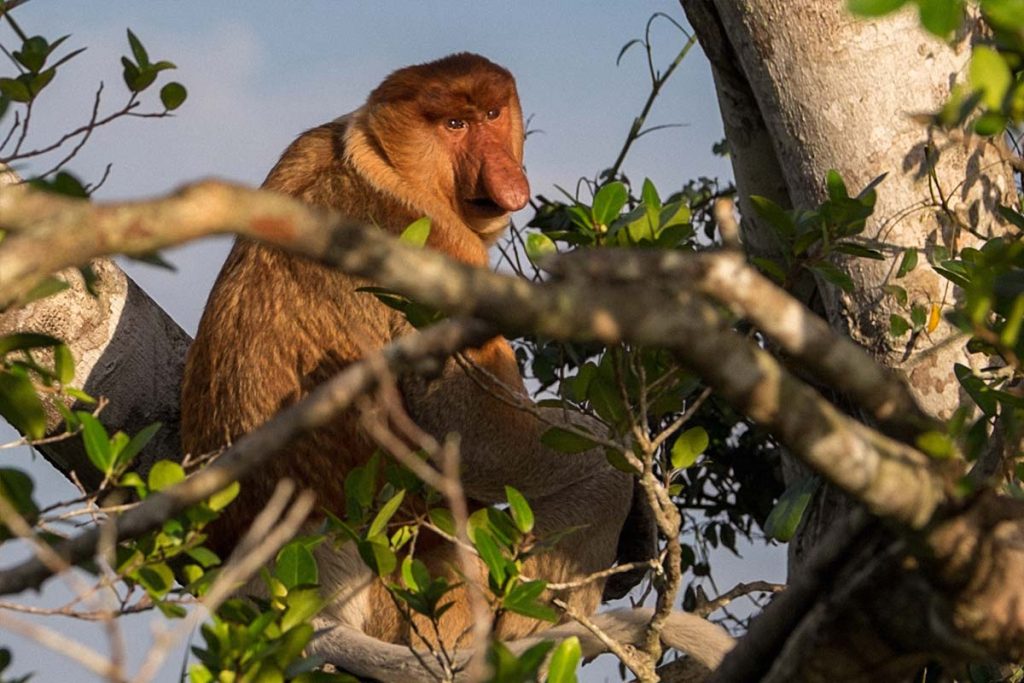
The proboscis monkey (Nasalis larvatus) is one of Borneo’s most unique primates and is easily identified by its unusually large nose, especially in adult males. This nose is believed to play a role in vocal amplification and mating displays. Males also have larger bodies and prominent pot-bellies caused by their specialized stomach structure, which helps digest fibrous leaves.
Proboscis monkeys are highly adapted to wetland environments. They are strong swimmers and are often found near rivers, mangroves, and coastal swamp forests. In Sabah, they are strongly associated with the Kinabatangan River system, where forest and water habitats are closely connected.
Their social structure typically involves one dominant male with multiple females and offspring, forming groups that may split or merge depending on food availability. They are most active during early morning and late afternoon, when they move between feeding and resting sites.
Diet consists mainly of young leaves, unripe fruits, and seeds. This specialized diet makes them dependent on healthy riparian and mangrove forests, which are sensitive ecosystems.
The species is classified as Endangered, with major threats including habitat loss from logging, drainage of wetlands, and land conversion. In Sabah river safari animals tours, proboscis monkeys are among the more commonly observed species due to their strong association with riverbanks. They are often seen resting in trees close to water or moving in groups along forest edges.

The rhinoceros hornbill is one of Borneo’s most iconic birds and is often considered a symbol of the rainforest. It has a large curved bill topped with a casque, striking black and white feathers, and a loud, echoing call that travels across forest valleys.
This bird inhabits lowland and hill rainforests across Sabah, including Danum Valley, Kinabatangan forest areas, and Tabin Wildlife Reserve. It prefers mature forests with tall trees for nesting.
The rhinoceros hornbill is classified as Vulnerable, mainly due to habitat loss and reduction of large nesting trees. It depends on old-growth forests, making forest protection essential for its long-term survival.
Sightings during Sabah wildlife tours usually happen in forested areas rather than open river views. It is often seen flying between trees or perched high in the canopy, especially during early morning hours.

Picture of baby crocodile
The estuarine crocodile is the largest reptile in the world and is widely distributed across coastal regions and river systems in Southeast Asia and northern Australia. In Sabah, it is commonly found in river systems such as the Kinabatangan River and nearby estuaries.
This species is a powerful predator and plays an important role in maintaining aquatic ecosystem balance. It usually rests along riverbanks or floats quietly in the water, making it difficult to detect unless guided carefully.
The estuarine crocodile is classified as Least Concern, but local populations still depend on healthy wetland ecosystems for survival.
During Kinabatangan wildlife river cruises, crocodile sightings are possible, especially during low-light conditions such as early morning or evening. However, they are generally shy and avoid human presence when disturbed.
The Kinabatangan River is the longest river in Sabah and one of the most important wildlife areas in Borneo. It stretches for about 560 kilometers and flows through many forest areas, wetlands, and floodplains. These different environments create a rich habitat where many animals can live and move freely.
The lower part of the Kinabatangan River is the most popular for wildlife viewing. This area still has patches of natural forest along the riverbanks, and it supports a high number of animals. Because of this, it is one of the main places for Borneo wildlife safari and Kinabatangan wildlife tours.
River cruises here are one of the best ways to explore wildlife in Sabah. Visitors may see proboscis monkeys sitting in trees near the river, Bornean pygmy elephants moving along the riverbank, and estuarine crocodiles resting in the water. Orangutans also live in the surrounding forests, but they are harder to spot because they move quietly and cover large areas.
The river system is very important for wildlife survival. The forest along the river helps animals move between different areas safely. Because of this, conservation groups work to protect land along the Kinabatangan so animals can continue to live and move in this region.
Danum Valley is a large protected rainforest in eastern Sabah, covering around 43,800 hectares. It is one of the oldest and most natural rainforests in Southeast Asia, with very little human disturbance. This makes it an important place for wildlife protection and scientific research.
The forest here is dense and tall, with many large trees, rivers, and natural trails. It is home to all five animals in the Borneo Big 5 list, along with many other species of birds, insects, and mammals.
Visitors usually stay at the Danum Valley Conservation Area, the research stations or jungle lodges inside the conservation area. One of the main accommodation options here is the Borneo Rainforest Lodge, which is located inside Danum Valley and is known for offering direct access to primary rainforest trails and guided nature walks. Staying here allows visitors to explore the forest early in the morning and at night, when wildlife activity is often higher.
Unlike river safaris, this area focuses more on jungle trekking and forest walks. Guided tours help visitors explore the rainforest while learning about plants, animal tracks, and natural sounds.
Wildlife sightings in Danum Valley are possible but not guaranteed. Animals such as orangutans or elephants move freely, so they may or may not be seen during a visit. Patience and quiet movement are important when exploring this area.
Danum Valley is also used by scientists who study rainforest ecosystems. Their research helps improve understanding of how animals live and how forests should be protected for the future.
Tabin Wildlife Reserve is another large protected area in eastern Sabah, covering about 49,000 hectares. It consists mainly of lowland rainforest and secondary forest, which were previously affected by logging but are now protected and recovering.
This reserve is an important habitat for many wildlife species, including Bornean pygmy elephants, orangutans, and various birds and reptiles. Over time, Tabin has become an important location for Sabah wildlife tours because it supports healthy populations of animals that are harder to find in more developed areas.
Visitors to Tabin usually join guided tours, which may include jungle walks, wildlife watching, and visits to natural sites inside the reserve. The environment is quiet and natural, giving a real rainforest experience.
Like other rainforest areas in Sabah, wildlife sightings are not guaranteed. Animals move across large areas, so their presence depends on time, weather, and natural behavior. However, the reserve remains an important place for long-term wildlife conservation.
Besides the main protected areas, Sabah also has many other forest reserves and conservation zones that support wildlife from the Borneo Big 5. These include places like Maliau Basin, Deramakot Forest Reserve, and several smaller protected forest areas across the state.
These regions are less visited by tourists, but they are very important for protecting wildlife habitats. They help maintain forest connections that allow animals to move safely between larger conservation areas.
Even though they are not always part of regular Borneo wildlife safari routes, these forests play a key role in keeping Sabah’s ecosystems healthy and supporting long-term wildlife survival.
River safaris are one of the easiest ways to explore Sabah wildlife tours, especially along the Kinabatangan River. These tours are done by boat and usually follow the river while passing through forest areas on both sides.
Most river safaris are scheduled in the early morning or late afternoon. These times are better because many animals are more active when the weather is cooler. A typical boat trip lasts about two to three hours.
During these tours, visitors may see proboscis monkeys in trees near the river, Bornean pygmy elephants moving along the riverbanks, and sometimes estuarine crocodiles in the water. Orangutans may also be seen in nearby forest areas, but sightings are not guaranteed.
River safaris are suitable for most people because they do not require walking long distances or physical effort. This makes them a popular choice for families and general travelers. Local guides also help explain animal behavior and point out wildlife that is not easy to notice.
Jungle trekking tours offer a more direct experience inside the rainforest. Instead of staying on the river, visitors walk through forest trails in places like Danum Valley and Tabin Wildlife Reserve.
These treks go deeper into the natural environment, where visitors can see forest structures, animal tracks, and different plant species up close. It gives a better understanding of how rainforest ecosystems work.
Jungle trekking requires a reasonable level of fitness because the terrain can be uneven, humid, and sometimes muddy. Walks usually start early in the morning when animals are more active and easier to observe.
Wildlife sightings are possible but not guaranteed. Animals move freely in large forest areas, so encounters depend on timing and conditions.
Some tours combine different activities into one experience. These guided wildlife observation programs may include river safaris, short jungle walks, and visits to conservation or research areas.
The purpose of these tours is to give visitors more chances to see Borneo Big 5 animals while also learning about conservation work in Sabah. Guides explain how the forest is protected and how animals survive in their natural environment.
This type of tour is useful for travelers who want both wildlife viewing and basic ecological understanding in one trip.
Morning and evening boat cruises are very important for wildlife viewing in Sabah. Many animals are more active during cooler hours, especially early in the day and before sunset.
Dawn cruises often provide calm conditions on the river, with higher chances of seeing birds, monkeys, and sometimes larger mammals near the riverbanks. Evening cruises are also good for spotting crocodiles and other nocturnal or resting animals.
Because of this natural behavior, many Kinabatangan wildlife tours offer multiple boat sessions per day to improve the chances of wildlife sightings under different conditions.
Experienced guides play a very important role in Borneo wildlife safari experiences. They know animal habits, movement patterns, and the best places to look along the river or forest trails.
Their knowledge helps visitors notice wildlife that might otherwise be missed. They also understand safety rules and guide visitors through natural environments responsibly.
Local guides often have years of experience in specific areas like the Kinabatangan River or Danum Valley. This helps improve the quality of wildlife observation and ensures tours are conducted safely and respectfully toward nature.
Choosing a tour with skilled guides can make a big difference in both learning about wildlife and having realistic expectations about sightings.
Wildlife travel in Sabah is strongly influenced by natural conditions, so timing and expectations matter. The region generally has a tropical climate with rainfall throughout the year, although some months are drier than others. Wildlife can be seen year-round, but behavior may vary depending on weather and water levels.
Light clothing is suitable for hot and humid conditions, and waterproof gear is useful due to sudden rain. Binoculars are highly recommended for river safaris and forest walks, as many animals are often seen at a distance or high in the trees.
Insect repellent is essential for jungle and river environments. Visitors should also wear comfortable footwear suitable for wet and uneven terrain.
Wildlife sightings are never guaranteed. Animals move freely in their natural habitat, and encounters depend on many environmental factors. Respecting distance and following guide instructions is important for both safety and conservation.
Responsible tourism practices are encouraged throughout Sabah’s protected areas. This includes avoiding loud noise, not feeding wildlife, and maintaining a safe distance from animals at all times.
We at Remarkable Borneo Travel and Tours offer structured wildlife packages designed to combine multiple conservation areas and habitats in a single journey. These packages bring together guided rainforest exploration, river safaris, and accommodation at lodges positioned close to wildlife corridors, which reduces travel time and maximizes viewing opportunities.
The 5D4N Sepilok, Kinabatangan & Danum Valley Field Centre package from RM5,260 combines three key wildlife zones. This itinerary typically includes time along the Kinabatangan River for river cruises where proboscis monkeys, elephants, and crocodiles are frequently sighted, paired with rainforest exploration in Danum Valley where visitors encounter orangutans and other primary forest species. The package balances river-based wildlife viewing with jungle trekking experiences.
For travelers with more time, the 8D7N Sabah Wildlife Adventure Experience from RM10,725 provides extended access to Sabah’s wildlife across multiple habitats. This longer itinerary allows visitors to spend adequate time in each location to understand different ecosystems and increase the likelihood of encountering various Big 5 species. Longer stays in single locations also allow guides to adjust daily activities based on wildlife patterns observed over previous days.
Both packages are structured around known wildlife movement patterns and seasonal activity, with daytime and evening cruises scheduled at times when animals are most active. Packages include accommodation at established jungle and river lodges within or adjacent to protected areas, meals, guided activities, and transportation between locations. This all-inclusive approach simplifies trip planning for visitors who prefer a structured itinerary over building their own custom tour.
The Borneo Big 5 represents some of the most important wildlife species found in Sabah’s rainforest ecosystems. These animals reflect the ecological richness of Borneo and highlight the importance of protecting natural habitats.
From orangutans in forest canopies to proboscis monkeys along riverbanks, and from hornbills flying across treetops to crocodiles resting in quiet waters, each species plays a role in maintaining ecological balance.
Sabah wildlife tours and Borneo wildlife safari experiences offer a chance to observe these animals in their natural environment, especially through river-based exploration in areas like Kinabatangan. However, these encounters depend entirely on nature, making each journey different.
Responsible wildlife tourism helps support conservation efforts while preserving habitats for future generations. The Borneo Big 5 continues to represent not just tourism interest, but also the long-term ecological value of Sabah’s rainforests.